
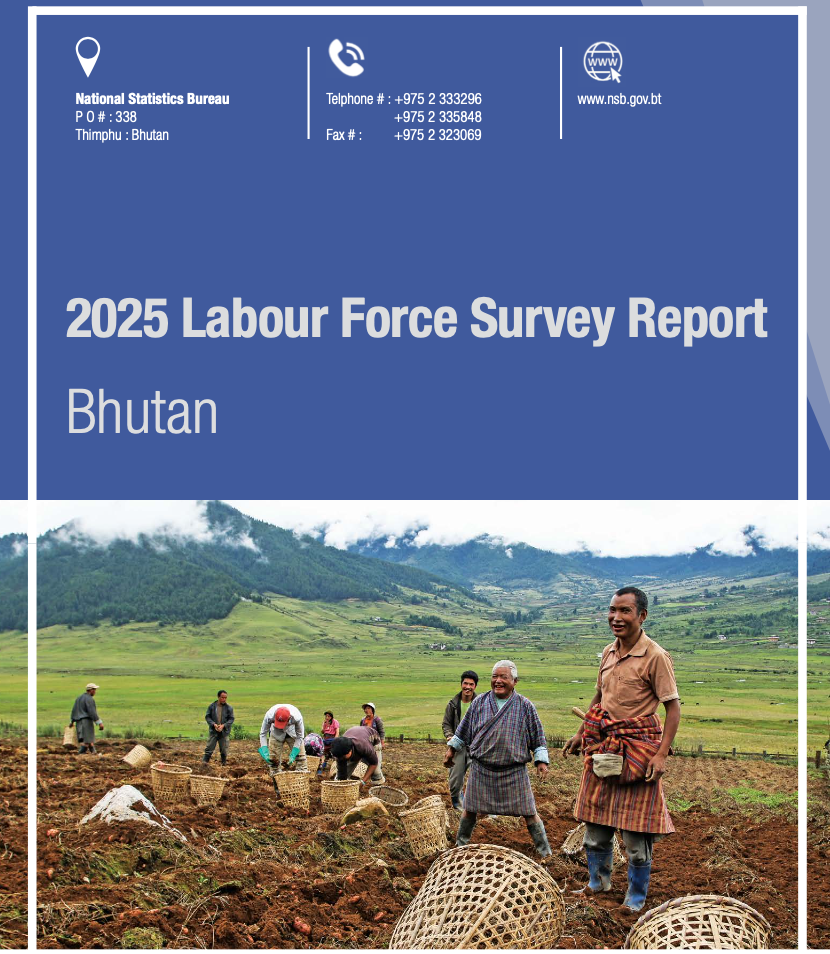
The Labour Force Survey (LFS) is conducted on a quarterly basis, and the annual report is the combination of data from all four quarters. The survey aims to provide information
on key labour market indicators and their associated characteristics, in line with the International Labour Organization (ILO) standards. A total of 11,888 households were selected across the twenty dzongkhags over the four quarters. Data collection is carried out throughout the year to capture seasonal variations in the labour market. Of the 11,888 sample households, 11,686 responded to the survey, resulting in an impressive annual response rate of 98.3 percent.
Key Findings
The information related to labour and employment indicators were collected from persons
aged 15 years and above.
I. Labour Force Participation Rate (LFPR)
The overall Labour Force Participation Rate (LFPR) has fluctuated over the years, declining to 64.9 percent in 2025 from 69.1 percent in 2021.
Male LFPR remains consistently higher than female participation, standing at 73.5 percent in 2025 compared to 55.6 percent for females.
Female LFPR has declined notably from 65.3 percent in 2021 to 55.6 percent in 2025, suggesting increasing barriers to women’s participation in the labour market.
II. Economically Inactive Population
The economic inactivity rate has increased from 30.9 percent in 2021 to 35.1 percent in 2025.
Women (44.4%) are significantly more likely to be economically inactive than men (26.5%), highlighting gender-related challenges in accessing employment.
Approximately 57 percent of the economically inactive population resides in rural areas, while 43 percent live in urban areas.
III. Employment Rate
The overall employment rate stood at 96.6 percent in 2025, recovering from 94.1 percent in 2022.
Male employment rates remain slightly higher (97.4% in 2025) compared to females (95.5% in 2025).
Of the total 381,584 employed persons, 251,938 (66.0%) reside in rural areas, while 129,646 (34.0%) live in urban areas. The distribution of employed persons by sex is
59.7 percent male and 40.3 percent female.
Among employed persons, the largest share is engaged in the agriculture sector (43.6%), followed by the service sector (42.2%), while the industry sector accounts for
the smallest share (14.2%).
IV. Unemployment Rate
The unemployment rate declined from 5.9 percent in 2022 to 3.4 percent in 2025.
Female unemployment (4.5%) remains higher than male unemployment (2.6%) in 2025.
The highest unemployment rate was recorded in 2022 (5.9%), reflecting the post-pandemic economic recovery phase.
Unemployment is largely an urban phenomenon, with a rate of 6.0 percent – about three times higher than in rural areas (2.0%).
Thimphu has the highest unemployment rate at 6.2 percent, followed by Sarpang (5.3%), Chhukha (4.5%), and Paro (4.4%).Gasa has the lowest unemployment rate at
0.6 percent, followed by Trashigang and Tsirang at 0.8 percent each.
V. Youth Unemployment Rate
Youth unemployment remains a critical challenge, standing at 18.0 percent in 2025 – lower than the peak of 28.6 percent in 2022, but still significantly higher than the overall
unemployment rate.
Male youth unemployment declined to 14.2 percent in 2025 (down from 24.4% in 2022).
Female youth unemployment remains high at 21.9 percent in 2025, indicating persistent barriers for young women in accessing employment.
Youth account for 45.1 percent of the total unemployed population. Among unemployed youth, 57.2 percent reside in urban areas, while 42.8 percent are in rural areas.
The 2025 Labour Force Survey Report can be downloaded from here
